 Carte fidélité
 Mollat Radio


Suggestions de mots clés
Suggestions de contenus éditoriaux
Chargement...
Suggestions littéraires
Chargement...
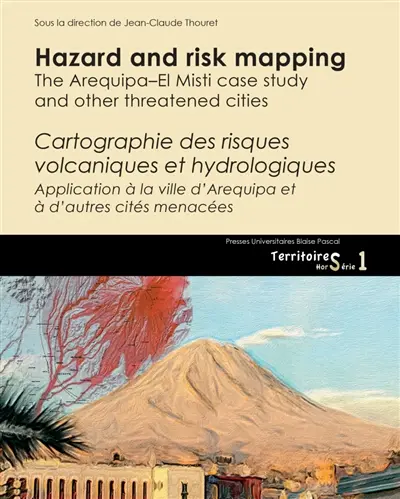
Avec un million d'habitants à moins de 20 km du volcan actif Misti, Arequipa, au Pérou, est l'une des villes les plus vulnérables du monde. Ces contributions visaient à fournir une méthodologie permettant d'évaluer l'aléa et le risque des écoulements volcaniques et hydrologiques dans ce milieu urbanisé. ©Electre 2026
Hosting almost one million people at a distance of 17 km away from the El Misti active volcano, Arequipa in southern Peru is one of the most vulnerable cities worldwide, where flash floods and mudflows cause fatalities and severe damage every two to five years on average. Which methodologies can we use to better assess hazard and risk of volcanic mass flows and floods in urban environments ? This central question was the rationale to bring together 50 national and international experts, graduate and PhD students, civil engineers together with civil authorities and risk management professionals, in the city of Arequipa.
The week-long workshop combined talks, debates, and field observations in valleys across the city together with modeling practice for pyroclastic density currents, lahars and flash floods using an online geomatic platform. The flow simulation outputs along three valleys across the city of Arequipa, embedded in a urban GIS, have improved vulnerability maps, showing the potentially affected habitat, infrastructure and water networks, all of which are critical assets in case of volcanic crises.
With the aim to create contingency and risk maps along with recommendations at the scale of urban districts, scientists in conjunction with risk management professionals have explored how critical model input parameters can be calibrated, how various sources of uncertainties on the model outputs can be correctly estimated, and how these different concepts can be disseminated to exposed communities. The outcomes of the final debate allowed to better define the key methodologies and priority tasks to undertake in order to improve hazard assessment and disaster risk management in urban environments.
Paru le : 31/03/2018
Thématique : Géosciences
Auteur(s) : Non précisé.
Éditeur(s) :
Presses universitaires Blaise Pascal
Collection(s) : Territoires
Contributeur(s) : Directeur de publication : Jean-Claude Thouret - Préfacier : Jackeline Choque Cuno - Préfacier : Marco Rivera Porras
Série(s) : Non précisé.
ISBN : 978-2-84516-639-4
EAN13 : 9782845166394
Reliure : Broché
Pages : 153
Hauteur: 25.0 cm / Largeur 20.0 cm
Épaisseur: 0.8 cm
Poids: 379 g