 Carte fidélité
 Mollat Radio


Suggestions de mots clés
Suggestions de contenus éditoriaux
Chargement...
Suggestions littéraires
Chargement...
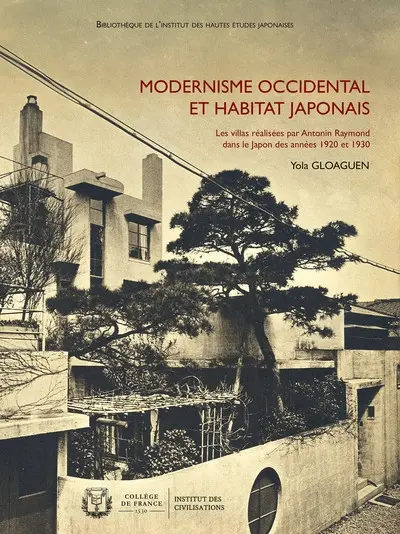
Cet ouvrage étudie la vie et l'oeuvre de l'architecte américain d'origine tchèque Antonin Raymond (1888-1976) dans le Japon de l'entre-deux-guerres. Initialement invité à la fin de l'année 1919, avec son épouse et collaboratrice, l'artiste et créatrice Noémi Pemessin-Raymond (1889-1980), à rejoindre l'équipe tokyoïte de Franck Lloyd Wright (1867-1959) qui réalise le nouvel Hôtel impérial, Raymond fonde sa propre agence en 1921 et entame une carrière prolifique dans la capitale nippone. Durant l'entre-deux-guerres, il développe un processus de conception architecturale puisant à la fois dans les innovations théoriques et techniques du modernisme occidental et dans la culture spatiale et les techniques de construction locales. À l'instar de nombre de ses pairs européens et américains pionniers du mouvement moderne, Raymond utilise le médium de la maison individuelle d'architecte pour expérimenter et donner forme à cette approche, avec le soutien de son équipe.
Organisé en trois parties, ce livre explore les différentes étapes de la construction de ce processus de conception architecturale. Il s'ouvre sur une biographie présentant le parcours qui mène Raymond de sa Bohême natale jusqu'au Japon, en passant par les États-Unis, dans la période à la fois tourmentée et fertile de la fin du XIXe et du début du XXe siècle. Il se poursuit avec l'examen des circonstances dans lesquelles Raymond s'établit en tant qu'architecte indépendant à Tokyo, constitue une équipe, et acquiert un certain nombre d'outils théoriques et techniques nécessaires à la pratique architecturale moderne dans le contexte japonais des années 1920 et 1930. Enfin, une sélection de villas réalisées dans la capitale et les destinations de villégiatures environnantes entre 1921 et 1938 est présentée. L'analyse architecturale détaillée de ces habitations réalisées pour une clientèle élitaire japonaise et occidentale permet d'observer les différentes étapes de l'élaboration du processus de conception architecturale qui a permis à Antonin Raymond, avec l'aide de son équipe d'abord internationale puis majoritairement japonaise, de proposer une architecture à la fois universelle et ancrée dans un contexte local. Par le biais de l'architecture, ce travail explore des problématiques et des enjeux soulevés par le processus de modernisation qui caractérise l'histoire du Japon de la première moitié du XXe siècle.
This book examines the life and work of Czech-born American architect Antonin Raymond (1888-1976) in interwar Japan. Initially invited in late 1919, along with his wife and collaborator, artist and designer Noémi Pemessin-Raymond (1889-1980), to join Frank Lloyd Wright's Tokyo team working on the new Imperial Hotel, Raymond established his own practice in 1921 and embarked on a prolific career in the Japanese capital. During the interwar period, he developed an architectural design process that drew both on the theoretical and technical innovations of Western modernism and on local spatial culture and construction techniques. Like many of his European and American peers at the forefront of the modem movement, Raymond used the medium of the architect's private house to experiment and give form to this approach, supported by his team.
Organized in three parts, this book explores the various stages in the construction of Raymond's architectural design process. It begins with a biography tracing his journey from his native Bohemia to Japan, via the United States, during the tumultuous yet fertile period of the late 19th and early 20th centuries. It then examines the circumstances under which Raymond established himself as an independent architect in Tokyo, assembled a team, and acquired the theoretical and technical tools necessary for modem architectural practice in the Japanese context of the 1920s and 1930s. Finally, a selection of villas built in the capital and nearby resort destinations between 1921 and 1938 is presented. The detailed architectural analysis of these residences, designed for a Japanese and Western elite clientele, reveals the successive stages in the development of the design process that enabled Antonin Raymond, with the help of his initially international and later predominantly Japanese team, to propose an architecture that was both universal and deeply rooted in a local context. Through architecture, this work explores the issues and challenges raised by the process of modernization that characterized Japan's history in the first half of the 20th century.
Paru le : 29/04/2026
Thématique : Autres réalisations architecturales Monographies d'architectes Autres pays
Auteur(s) : Auteur : Yola Gloaguen
Éditeur(s) :
Collège de France, Institut des hautes études japonaises
Collection(s) : Bibliothèque de l'Institut des hautes études japonaises
Série(s) : Non précisé.
ISBN : 978-2-913217-39-3
EAN13 : 9782913217393
Reliure : Broché
Pages : 599
Hauteur: 28.0 cm / Largeur 21.0 cm
Épaisseur: 4.5 cm
Poids: 1550 g