 Carte fidélité
 Mollat Radio


Suggestions de mots clés
Suggestions de contenus éditoriaux
Chargement...
Suggestions littéraires
Chargement...
T. Woda met la chance au coeur de son témoignage en montrant comment il parvint à échapper à la Shoah. Celle-ci intervient au cours de sa déportation à Auschwitz lorsqu'il est sélectionné pour le travail forcé. ©Electre 2026
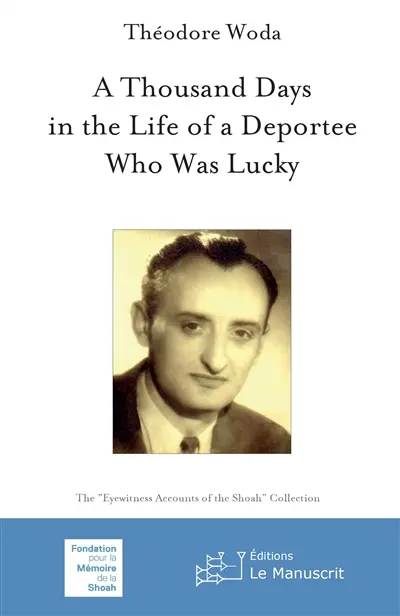
A Thousand Days in the Life of a Deportee Who Was Lucky
Holocaust survivors often say that the circumstances in which they defied death were a matter of sheer luck. They also mention the random, arbitrary nature of the Nazi concentration camp system. Théodore Woda puts luck at the heart of his story, showing that, although the Third Reich was intent on destroying all the Jews of Europe, gas chambers or a slow death by starvation and/or mistreatment did not always lie at the end of the road.
It cannot really be said that luck was on Théodore's side when the Gestapo arrested him during a spot check for the sole crime of being Jewish and deported him from the Drancy camp on transport 33. His « luck », then, was relative. It came into play when the train taking him to the Auschwitz extermination camp stopped at the railway station in Opole, where he and some fellow deportees were selected for slave labor. But during the 32 months he spent in three slave labor and two concentration camps in Silesia, Théodore's « luck » did not keep him safe from hunger, beatings, unhygienic conditions and abuse. As he relates in plain, matter-of-fact words, he was « lucky » to work in workshops, know German and possess the resourcefulness to live by his wits. Under those circumstances, he managed not only to find food to supplement his insufficient diet, but to correspond with his family and even receive parcels sent to him under the names of men in the STO (the French acronym for Service de travail obligatoire, or Compulsory Labor Service).
In sum, he was « lucky » to return alive from the maelstrom that claimed the lives of his mother, two of his brothers, one of his sisters, his uncle and his aunt.
His testimonial has been unpublished until now.
Paru le : 22/04/2016
Thématique : Récits de vie
Auteur(s) : Auteur : Théodore Woda
Éditeur(s) :
le Manuscrit-www.manuscrit.com
Fondation pour la mémoire de la Shoah
Collection(s) : Eyewitness accounts of the Shoah
Contributeur(s) : Traducteur : Glenn Naumovitz
Série(s) : Non précisé.
ISBN : 978-2-304-04564-2
EAN13 : 9782304045642
Reliure : Broché
Pages : 147
Hauteur: 23.0 cm / Largeur 14.0 cm
Épaisseur: 1.2 cm
Poids: 90 g