 Carte fidélité
 Mollat Radio


Suggestions de mots clés
Suggestions de contenus éditoriaux
Chargement...
Suggestions littéraires
Chargement...
Le droit international contient des règles, des institutions et des régimes qui peuvent être perçus comme des outils de résistance pour les personnes, groupes ou Etats en position de subordination. Le propos de l'auteur est de montrer que ce que ce droit international propose en matière de résistance et d'émancipation n'outrepasse jamais ce qui est tolérable pour les dominants. ©Electre 2026
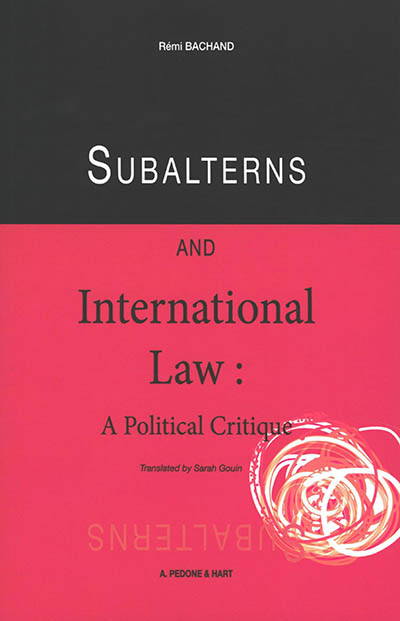
Subalterns and international law
What is the role of international law in the different societies of the world? What are its effects on the various relations of domination and exploitation that permeate and structure these societies? Should it be seen as being more favourable to dominant groups or to subalterns? Should the latter use international law as the main weapon in their fight against different forms of subordination, or should it be used only in certain strategic circumstances? This book proposes hypotheses to answer these and other questions.
Seeking in particular to radicalise the vocabulary used by critical international lawyers, the author of this book aims to theorise the effects of international law on relations between dominant and subaltern groups In different societies around the world. More specifically, he seeks to understand its role in the reproduction, legitimation, contestation, and transformation of systems of social relations of subordination such as capitalism, patriarchy, racism, and imperialism, which constitute the matrices of subordination in these societies. Essentially, this book considers that these effects occur at four distinct moments, namely when law structures international society, for example by organising it territorially into sovereign and formally equal States; when its rules and institutions are formally used by the various actors who are in a position to do so; when it is a factor influencing the different ideological formations in the world; and, finally, when it is used as a language for legitimately defending political claims.
The ambition of this book is to show that because of its structure, international law Is an extremely powerful tool for promoting the reproduction and legitimation of social relations of subordination. Of course, it also contains rules, institutions, and regimes that are perceived as tools of resistance and as propositions for emancipation projects for subalterns, and it is regularly used as such. In the latter cases, however, it must be said that what international law proposes in terms of resistance and emancipation never goes beyond what is tolerable for the dominants.
Paru le : 01/03/2022
Thématique : Droit international
Auteur(s) : Auteur : Rémi Bachand
Éditeur(s) :
Pedone
Hart publishing
Collection(s) : Non précisé.
Contributeur(s) : Traducteur : Sarah Gouin
Série(s) : Non précisé.
ISBN : 978-2-233-01000-1
EAN13 : 9782233010001
Reliure : Broché
Pages : 224
Hauteur: 24.0 cm / Largeur 16.0 cm
Épaisseur: 1.0 cm
Poids: 0 g